Gods Born from Silence: How History's Most Forgotten Empires Could Reshape Fantasy Forever
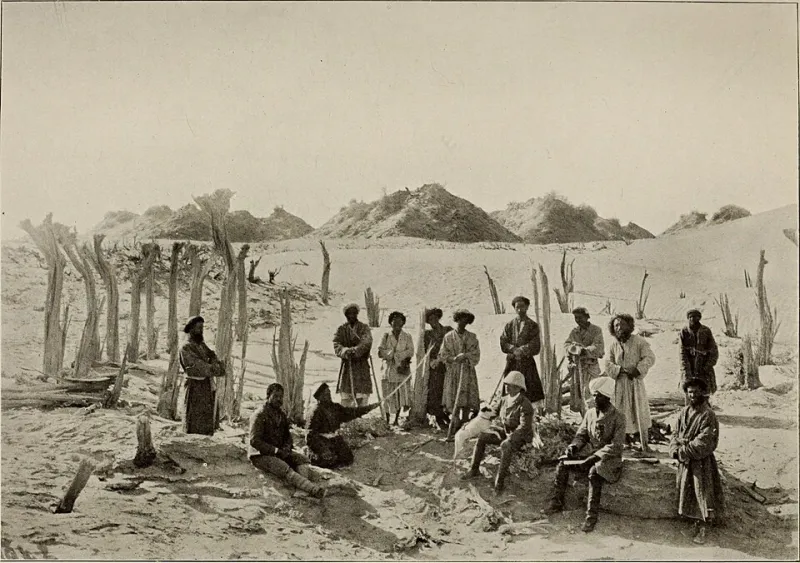
Photo: Stein, Aurel, Sir, 1862-1943; Archaeological Survey of India, No restrictions, via Wikimedia Commons
There is a particular kind of mythology that no library fully contains. It does not belong to Zeus or Odin, to Ra or Vishnu. It belongs instead to civilizations that raised monuments to powers they never bothered — or never had the chance — to explain in writing. These are the gods of the vanished empires: the Nabataeans of the Arabian desert, the Aksumites of the Ethiopian highlands, the Cahokians of the American Midwest. Their sacred architecture still stands. Their divine names, when they survive at all, arrive stripped of story. And for that very reason, they may represent the most fertile creative territory fantasy has yet to claim.
Fantasy worldbuilding has long operated under a quiet orthodoxy. Designers and novelists reach instinctively toward the well-documented: Greek myth, Norse cosmology, Arthurian legend, Hindu cosmology. These traditions are rich, certainly. But their richness also imposes constraint. Every writer who conjures a thunder god labors under the shadow of Thor. Every underworld risks comparison to Hades. The more complete a mythology, the more a creative work must contend with its predecessor — explaining divergence, managing audience expectations, or simply struggling to feel original.
The forgotten empires offer a different proposition entirely. They offer the outline of a divine world without the interior.
The Nabataeans and the Architecture of Absence
Consider Petra. The city carved into the sandstone cliffs of southern Jordan remains one of the ancient world's most visually astonishing achievements, and the Nabataean civilization that built it controlled trade routes connecting Arabia, Egypt, and the Mediterranean for centuries. They worshipped a pantheon of deities — Dushara, the supreme male god associated with mountains and stone; Al-Uzza, a goddess whose nature scholars still debate; Allat, whose cult stretched across the Arabian world. Their temples survive. Their devotional inscriptions survive. What does not survive, in any meaningful quantity, is theology: the stories, the cosmologies, the divine relationships that would have given those names their full meaning.
For a fantasy writer, this is not a problem. It is an invitation.
A god defined only by his mountain associations and his carved, featureless stone blocks — the betyls that Nabataean worshippers venerated — is a god waiting to receive a mythology. What did Dushara demand of his people? What did he promise in return? What was his relationship to the trade winds and the desert storms that governed Nabataean prosperity? None of this is known. All of it can be imagined. And because it can be imagined without contradicting established sacred texts, it can be imagined freely, without the guilt of appropriation that rightly shadows more thoroughly documented living traditions.
Aksum and the Gods the Obelisks Outlasted
The Aksumite Empire, centered in what is now northern Ethiopia and Eritrea, reached its peak between the first and seventh centuries CE. At its height, it was counted among the four great powers of the ancient world alongside Rome, Persia, and China. Its rulers erected towering stelae — obelisks that still stand today — and minted coins bearing royal portraits. Aksum eventually converted to Christianity in the fourth century, an event that effectively buried whatever came before.
The pre-Christian Aksumite pantheon included deities such as Mahrem, a war god associated with the planet Mars and invoked in royal inscriptions, and Astar, a celestial deity whose precise nature remains uncertain. Beyond these fragments, the religious landscape of ancient Aksum is largely reconstructed from inference — from Sabaean parallels, from material culture, from the silences between inscriptions.
What makes the Aksumite case particularly compelling for worldbuilding is the civilizational scale involved. This was not a minor regional culture. This was an empire that traded in ivory, gold, and incense with Rome and India, that built stone palaces and underground tombs of extraordinary ambition. A divine system capable of sustaining that kind of civilization would have been correspondingly complex — layered with priestly hierarchies, royal ritual, agricultural ceremony, and cosmic narrative. Almost none of it has survived. The writer who chooses to reconstruct it, imaginatively and responsibly, is not filling a small gap. They are constructing an entire sacred world from its foundations.
Cahokia and the American Gods We Never Told
Perhaps the most striking case of all belongs to North America. Between approximately 900 and 1300 CE, Cahokia — located near present-day St. Louis, Illinois — was the largest pre-Columbian city north of Mexico. At its peak, it may have housed as many as twenty thousand people. Its central earthwork, Monks Mound, remains the largest prehistoric earthen structure in North America. The city's layout appears to have been organized around astronomical alignments, suggesting a cosmological system of considerable sophistication.
And yet almost nothing of Cahokian religious belief has survived in documented form. The civilization's descendants — broadly associated with Mississippian cultures — left behind material evidence of a rich ceremonial life: the Southeastern Ceremonial Complex, with its recurring motifs of serpents, birds of prey, and human sacrifice. But the specific theology of Cahokia itself, the names and natures of the gods worshipped beneath those massive mounds, remains largely inaccessible.
For American fantasy writers in particular, this represents a profound opportunity. The United States has a deep and largely unexplored mythological inheritance that predates European contact by millennia. Cahokia sits in the geographic heart of the country. Its cosmological system, whatever it was, would have been shaped by the great rivers, the prairie skies, the cycles of corn and flood that defined life in the American Bottom. A fantasy tradition willing to engage seriously with that inheritance — not to appropriate living Indigenous traditions, but to imaginatively reconstruct a civilization that left its theology largely unwritten — could produce something genuinely new in the genre.
Building Gods from Archaeological Shadows
The creative principle at work here is not simply one of convenience. There is something philosophically meaningful about constructing divine beings from absence. A god known only through the proportions of his temple, the orientation of his altar toward a particular star, the animal bones found in his sacrificial precinct — that god arrives in the imagination fully charged with mystery. He has not been explained into familiarity. His demands remain opaque. His nature resists easy categorization.
This is, arguably, closer to the genuine phenomenology of ancient religious experience than the rationalized, narrativized mythology most fantasy draws upon. The Greeks and Norse left us their gods in relatively accessible literary form because later writers — Hesiod, Snorri Sturluson — codified and systematized what had been more fluid and localized. The gods of the forgotten empires never received that treatment. They remain, in a sense, more authentically divine: powerful, partially visible, their full nature perpetually withheld.
Fantasy has always been at its most resonant when it gestures toward something it cannot entirely show. The Nameless Gods of the forgotten empires are, by definition, precisely that: presences that exceed their own documentation. For writers willing to work in that territory — to build pantheons from cliff faces and coin iconography and astronomical alignments — they offer something the well-trodden mythologies no longer can.
They offer the genuine experience of encountering a god for the very first time.