Skins of Another World: The Indigenous American Transformation Myths That Fantasy Fiction Refuses to See
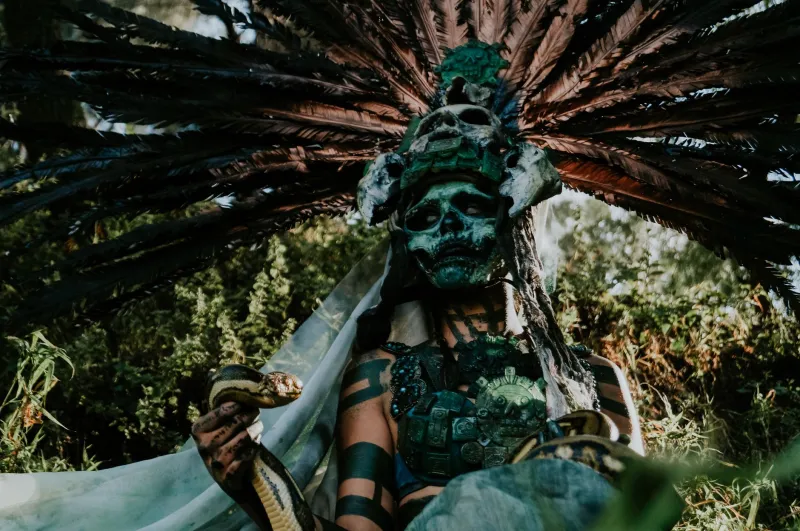
There is a particular kind of invisibility that does not announce itself. It does not arrive with a declaration or a manifesto. It simply accumulates, shelf by shelf, film by film, until an entire continent's mythological inheritance has been quietly rendered absent from the genre that claims, above all others, to celebrate the extraordinary.
Contemporary fantasy literature is saturated with shapeshifters. Werewolves prowl urban streets in bestselling series. Selkies shed their seal-skins in literary fiction praised for its lyrical originality. Skinchangers inherited from Old Norse tradition anchor epic fantasy sagas. The transformation narrative — the body as threshold, as permeable boundary between the human and the more-than-human — is among the most beloved devices in speculative fiction.
Yet the transformation traditions of Indigenous American peoples, traditions that span hundreds of distinct nations and carry thousands of years of philosophical and spiritual weight, remain almost entirely absent from the genre. This is not an accident. It is a pattern, and patterns have explanations.
The Continent That Fantasy Forgot
To speak of "Indigenous American transformation myths" as a single category is already to commit a mild distortion. The traditions in question are extraordinarily diverse. The Navajo concept sometimes rendered in English as the skin-walker — a figure who has acquired the ability to assume animal form, often through transgression of sacred boundaries — carries entirely different cosmological freight than the were-bear traditions found among certain Plains nations, or the transformer figures of the Pacific Northwest who reshape the world itself through acts of metamorphosis.
Among the Ojibwe and related Algonquian peoples, the concept of the manitou encompasses spiritual forces that move between forms, inhabiting and animating the natural world in ways that resist the rigid human/animal binary that Western thought tends to impose. Among the Pueblo peoples of the American Southwest, certain ceremonial traditions involve the ritual assumption of animal identities — not as metaphor, but as a genuinely understood ontological crossing.
These are not interchangeable. They are not simply the "Native American version" of the werewolf, waiting to be slotted into familiar genre templates. That, in part, is precisely why they have been excluded.
The Genre's Structural Preference for the Familiar
Modern fantasy, as a commercial genre, developed primarily within a framework shaped by Northern and Western European source material. Tolkien drew on Norse and Anglo-Saxon tradition. The urban fantasy boom of the 1990s and 2000s recycled Celtic and Germanic folklore. Even when writers have reached beyond Europe, they have tended to reach toward traditions with established Western scholarly frameworks — Greek myth, Egyptian cosmology — that had already been partially translated into terms legible to mainstream publishing.
Indigenous American mythological traditions present a different challenge. Many exist within living communities that have explicit, considered positions on how their sacred narratives should and should not be used. The skin-walker, in particular, occupies a sensitive position in Navajo tradition; many Navajo people have expressed discomfort with the casual way the concept has been appropriated by horror fiction and internet mythology, stripped of its cultural context and repurposed as a generic monster.
This sensitivity is legitimate and important. But it has also, in a publishing environment more comfortable with avoidance than with genuine engagement, contributed to a wholesale retreat from Indigenous American mythological material — a retreat that conflates respectful restraint with total erasure.
The Philosophical Stakes of the Transformation
What is lost in this erasure is not merely a set of colorful narrative devices. It is a fundamentally different philosophy of transformation itself.
The dominant European shapeshifter tradition tends to frame transformation as either a curse or a power — something imposed upon the human body from outside, or seized through transgression, that threatens the stable identity of the self. The werewolf fears the full moon. The selkie mourns her stolen skin. Even in more sympathetic contemporary retellings, the transformation is typically framed as a tension between two competing selves, the human and the animal, each struggling for dominance.
Many Indigenous American transformation traditions operate from an entirely different premise. Rather than positing a stable human self that is threatened or altered by animal form, they begin from a worldview in which the boundaries between human, animal, and spirit are inherently permeable — in which transformation is not an exception to the natural order but an expression of it. The figure who moves between forms is not necessarily a tragic hybrid or a dangerous aberration. They may be a mediator, a messenger, a being whose very fluidity is a form of wisdom.
This is a richer and more philosophically interesting premise than the curse-and-affliction model that fantasy fiction has largely inherited. It is also a premise that requires genuine engagement with its source traditions, rather than surface-level borrowing.
A New Generation of Voices
The landscape is not entirely static. A growing number of Indigenous American writers — many of them working explicitly within or adjacent to the fantasy and speculative fiction genres — have begun to bring these traditions into contemporary storytelling on their own terms.
Writers such as Tommy Orange, though primarily a literary novelist, have demonstrated that Indigenous American cosmological frameworks can anchor narratives of startling power and contemporary relevance. In the speculative fiction space, authors including Rebecca Roanhorse — whose Navajo heritage informs her fantasy work, and who has written thoughtfully about the complexities of drawing on living tradition — have opened conversations about what authentic engagement might look like, as opposed to extractive appropriation.
These conversations are overdue. They are also, for readers and writers willing to engage seriously, genuinely exciting. The transformation traditions of Indigenous American peoples represent not a niche interest for specialists but one of the most conceptually rich and narratively underexplored bodies of mythological material on the continent where most of their readers live.
The Arkhalia Argument
At Arkhalia, we hold that mythology is not a static archive. It breathes. It moves between forms — which is, perhaps, the most appropriate metaphor available when discussing traditions that have always understood the world as fundamentally fluid and animate.
The absence of Indigenous American transformation myths from mainstream fantasy is a wound in the genre's imagination, one that has persisted for reasons that are partly commercial, partly historical, and partly the result of a publishing industry that has too often mistaken avoidance for respect. The remedy is not appropriation — the casual grafting of sacred symbols onto familiar genre templates. The remedy is genuine engagement: reading widely, listening carefully to the communities whose traditions are at stake, and supporting the writers who carry those traditions within themselves.
The shapeshifter stands at the threshold between worlds. It is, by its nature, a figure that asks us to reconsider what we thought we knew about the boundaries of the self. Fantasy fiction, a genre built on the premise that imagination can cross any boundary, has no excuse for refusing that invitation.