Beneath the Hollow Hills: How Celtic Faerie Mythology Lost the Fantasy Wars — and Why That Loss Costs Us Everything
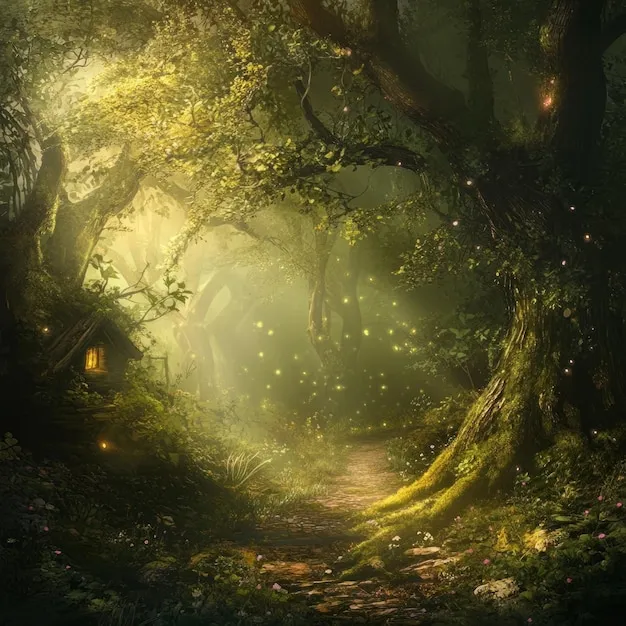
Photo: misty ancient Celtic forest hollow hills faerie mystical atmospheric, via img.freepik.com
Somewhere beneath the green hills of an older world, a queen with antler-pale skin presides over a court where time moves sideways and every bargain carries a consequence that will not arrive for a century. Her subjects are not the delicate winged creatures of greeting cards. They are ancient, capricious, and governed by rules so intricate they constitute their own form of cosmic law. This is the Otherworld of Celtic tradition — and modern fantasy fiction has largely left it undiscovered.
While Marvel's Thor anchors a multi-billion-dollar franchise and Percy Jackson introduces Greek mythology to a new generation of American readers every few years, the faerie courts of Irish, Welsh, and Scottish legend occupy a far quieter cultural shelf. That quietude is not a reflection of the mythology's depth. If anything, Celtic lore is richer in the specific qualities contemporary storytelling prizes most: psychological complexity, morally ambiguous power structures, and a horror that does not announce itself with thunder but arrives in silence, wearing a familiar face.
So what happened?
The Franchise Problem: When Myth Becomes Brand
Norse and Greco-Roman mythologies entered the American cultural bloodstream through channels that Celtic tradition simply never accessed at the same scale. Greek myth arrived via the classical education system — Latin classes, museum collections, Renaissance art reproduced in textbooks. Norse myth, long a staple of European Romanticism, received its definitive modern amplification through Tolkien, whose own academic work on Old Norse and Germanic sources shaped the foundational grammar of fantasy worldbuilding. By the time Marvel adapted those traditions for mass audiences, the iconography was already deeply familiar. Odin's ravens, Zeus's lightning bolt, Athena's owl — these are legible symbols, instantly recognizable to an American audience even without prior study.
Celtic mythology never received that same institutional laundering into mainstream consciousness. The primary texts — the Irish Lebor Gabála Érenn, the Welsh Mabinogion, the vast oral traditions of Scotland — remained largely the province of academic specialists and dedicated enthusiasts. American pop culture absorbed shamrocks and leprechauns, reductive shorthand that actively obscured the genuine strangeness beneath. The Tuatha Dé Danann, the divine race of Irish mythology, became party decorations. The Sídhe, the supernatural beings of the hollow hills, became Tinker Bell.
This reduction is not merely aesthetically unfortunate. It represents a genuine loss of narrative raw material.
What the Courts Actually Offer
The faerie courts of Celtic tradition operate according to a supernatural bureaucracy that is, frankly, more sophisticated than anything Olympus ever managed. The division between the Seelie and Unseelie Courts — terms drawn primarily from Scottish tradition — describes not simply a binary of good and evil but a taxonomy of motivation and obligation. The Seelie Court is not benevolent in any human sense; it is bound by codes of reciprocity and honor that produce benevolent outcomes as a byproduct of self-interest. The Unseelie Court is not evil so much as unconstrained — operating outside the social contracts that give the Seelie their legibility.
This is a more nuanced cosmological structure than the Olympian family drama or even the Norse framework of Ragnarök-bound fate. Celtic supernatural politics are about negotiation — about the terms under which power is exercised and the consequences of misreading those terms. For a culture saturated with stories about institutional corruption, corporate power, and the fine print in agreements that seem generous on the surface, this framework is extraordinarily resonant. It simply has not been deployed at scale.
The concept of geas — a magical obligation or prohibition placed upon a person, often with catastrophic consequences for violation — offers storytellers something that neither Greek fate nor Norse doom quite provides: a form of supernatural law that is personal, specific, and deeply ironic. Cú Chulainn, the great hero of the Ulster Cycle, is undone not by a monster or a god but by the intersection of two geasa that leave him no survivable choice. That is psychological horror of the highest order, and it belongs to a tradition that modern fantasy has barely touched.
The Works That Prove the Point
The exceptions are instructive. Holly Black's The Folk of the Air trilogy brought the court structure of faerie politics to a Young Adult audience with genuine sophistication, centering the power asymmetries and contractual treacheries that define the tradition. The series became a bestseller precisely because it treated the source material seriously rather than sanitizing it. Similarly, Susanna Clarke's Jonathan Strange & Mr Norrell — while drawing on English fairy tradition rather than strictly Celtic sources — demonstrated that the cold, alien quality of faerie power could anchor a novel of genuine literary ambition.
In television, the short-lived but critically admired The Bastard Son & the Devil Himself gestured toward this territory, and earlier, Merlin and Once Upon a Time incorporated Celtic-adjacent elements, though rarely with the commitment to internal mythology that would have elevated them. The animated series Hilda, adapted from Luke Pearson's graphic novels, built an entire world from Northern European folk tradition with a specificity that proved younger audiences are entirely capable of engaging with complex supernatural systems.
These examples share a common quality: they take the rules seriously. The horror and wonder of Celtic faerie tradition derive not from the power of the supernatural beings but from the structure within which that power operates. Strip away the rules and you have spectacle. Honor the rules and you have mythology.
The Colonial Shadow
There is a harder conversation embedded in this question. Celtic traditions were actively suppressed — by Roman conquest, by the spread of Christianity, and most devastatingly, by British colonial policy in Ireland, Scotland, and Wales. The preservation of Celtic mythology is itself an act of cultural recovery, and much of what survives does so in fragmentary, Christianized, or politically compromised form. The Tuatha Dé Danann, once divine, were recast as demons or diminished into faeries precisely because their original grandeur was theologically inconvenient.
American audiences inherit this suppression at a remove. The Irish diaspora in the United States is enormous — roughly 31 million Americans claim Irish ancestry — yet the mythology that traveled with those ancestors was largely replaced by a sentimental nationalism that preferred shamrocks to Sídhe. The tradition was present but rendered decorative, stripped of its cosmological weight.
Recovering that weight is not merely a creative opportunity. It is a form of cultural archaeology.
The Hollow Hills Are Still There
Modern fantasy is in a period of genuine expansion, actively seeking mythological traditions beyond its Eurocentric defaults. Celtic lore offers something that neither the currently fashionable West African nor Mesoamerican traditions — as rich as they are — quite replicates: a fully developed supernatural bureaucracy, a cosmology of negotiated power, and a horror tradition rooted not in monsters but in contracts.
The courts beneath the hollow hills have been waiting. Their queen still sits on her pale throne, and her terms are, as always, very specific. The question is whether contemporary storytelling is finally ready to read the fine print.