The Door at the Edge of the World: What Portal Fantasy Reveals About the Human Need for Elsewhere
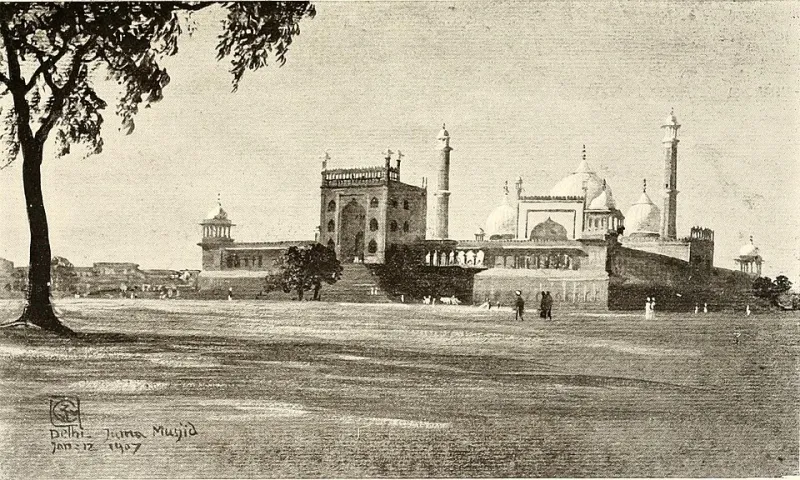
Photo: Internet Archive Book Images, No restrictions, via Wikimedia Commons
Every child who has ever pressed their hands against the back of a closet, half-hoping the wood might give way to something other than winter coats, understands the emotional logic of portal fantasy before they could articulate it. The genre does not require explanation or justification to its audience. It requires only a door—or a mirror, a rabbit hole, a wardrobe, a storm drain, a painting on a wall—and the implicit promise that what lies beyond it is more real, in some essential sense, than what lies behind.
This is a remarkable thing for a literary device to accomplish. The portal does not merely transport a character. It transforms the reader's relationship to ordinary space. Every threshold becomes provisional. Every piece of furniture with a back panel and every basement door left slightly ajar participates, however faintly, in the same imaginative logic.
The Architecture of Threshold
Portal fantasy as a recognizable genre convention solidified in the late nineteenth and early twentieth centuries, though its mythological antecedents are considerably older. The descent narratives of ancient mythology—Inanna entering the underworld through successive gates, Orpheus crossing the river Styx, Odysseus sailing to the land of the dead—share the structural DNA of every portal story that followed them. In each case, a boundary exists between the known world and a realm governed by different rules, and the crossing of that boundary is the narrative's central event.
What the modern portal fantasy tradition contributed was a specific inversion of the ancient model. In classical mythology, the extraordinary realm beyond the threshold is almost always dangerous, diminishing, or fatal. The underworld is not a better world—it is the absence of life and light. Heroes who cross into it do so reluctantly and at tremendous cost.
C.S. Lewis, writing The Lion, the Witch and the Wardrobe in 1950, made an adjustment that would prove enormously generative. His portal led not to a realm of diminishment but to one of heightened significance. Narnia is larger than England in every sense that matters to a child—more beautiful, more dangerous in ways that feel meaningful rather than merely threatening, and structured around a moral clarity that the postwar world conspicuously lacked. The children who enter through the wardrobe do not lose themselves. They become more themselves. They discover capacities for courage and leadership that the ordinary world had given them no occasion to develop.
This reversal—the portal as a passage toward greater rather than lesser vitality—defined the template that virtually every subsequent portal fantasy would follow.
Platform 9¾ and the Hidden World Next Door
J.K. Rowling's contribution to portal mythology is worth examining carefully, because it introduces a variation that speaks directly to a specifically American cultural anxiety. The magical world in the Harry Potter series is not geographically separate from the mundane one. It is spatially coincident with it—hidden within the same cities, the same train stations, the same streets. Diagon Alley occupies the same London as the City of London. Hogwarts exists in the same Scottish Highlands that Muggles walk through without seeing.
This is a fundamentally different proposition than Narnia, which is genuinely elsewhere. Rowling's portal does not take you to another world. It reveals the world you already inhabit as secretly double—as containing, within its familiar geography, an entire civilization that has been present all along.
The emotional resonance of this structure is difficult to overstate, particularly for American readers navigating the particular flatness of suburban life. The suggestion that the strip malls and cul-de-sacs and highway interchanges of ordinary American existence might conceal something extraordinary within their geometry—that the right door, the right perspective, the right knowledge might open onto a world of genuine significance—functions less as escapism than as a form of compensatory perception. It does not ask you to leave your world. It asks you to see your world differently.
The Portal as Psychological Necessity
Psychological readings of the portal fantasy trope tend to focus on adolescent development, and there is obvious merit to this approach. The portal story is, structurally, a coming-of-age narrative in which the threshold crossing corresponds to the psychological rupture of leaving childhood behind. The child who enters the magical world returns changed, carrying knowledge and experience that cannot be communicated to those who remained behind. This maps with uncomfortable precision onto the experience of growing up.
But the portal's appeal is not confined to adolescent readers, and the developmental reading, while useful, does not fully account for the genre's persistence across age demographics. Adults return to portal fantasy with a frequency and emotional investment that suggests the device is addressing something more than nostalgia for childhood liminality.
The more compelling psychological argument is that portal fantasy addresses a pervasive modern sense of ontological insufficiency—the feeling that the world as currently constituted is not quite enough. Not merely that it is difficult or painful, which is a different complaint, but that it is somehow incomplete. That something essential has been left out of the arrangement. That the texture of ordinary experience, for all its genuine pleasures and genuine sorrows, lacks a dimension that human consciousness is somehow built to expect.
This is, it should be noted, essentially a mythological intuition. The sense that the visible world is a surface beneath which more fundamental realities operate is among the oldest and most cross-culturally consistent features of human religious experience. Portal fantasy is, in this reading, a secular form of the same impulse that produced shamanic traditions, mystery religions, and the doctrine of the veil between the living world and the spirit world that appears in cultures from West Africa to pre-Columbian North America.
The Modern Portal and What It Has Become
Contemporary portal fantasy—from the television series Stranger Things and its explicitly named Upside Down to the interdimensional mechanics of the MCU's multiverse—has largely retained the emotional core of the classic tradition while updating its visual and conceptual vocabulary. The portal has become, if anything, more central to popular narrative than it was in the mid-twentieth century.
What has shifted is the nature of what lies beyond. Where Lewis offered moral clarity and Rowling offered hidden community, contemporary portal fantasy increasingly offers multiplicity—the suggestion that the extraordinary world is not a single destination but an infinite series of variations on the world we already know. The portal leads not to Elsewhere but to Elsewheres, plural and branching.
This evolution reflects something real about the cultural moment. The primal need the portal addresses—the need to believe that the world contains more than it appears to—has not diminished. If anything, it has intensified. The door at the edge of the world remains the most honest metaphor fiction has ever produced for the act of reading itself: the conviction that pressing through to the other side will show you something you could not have seen from where you started.