Between River and Shore: Why Fantasy Fiction Has Forgotten the World's Most Powerful Aquatic Shapeshifters

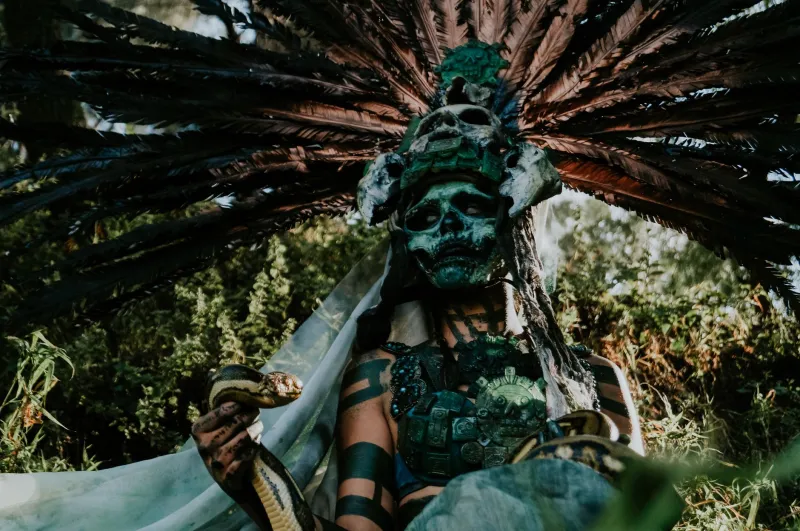
Photo by Photo by HARALD PLIESSNIG on Unsplash on Unsplash
There is a particular kind of myth that lives at the water's edge. Not fully in the river, not entirely on the bank — suspended in the liminal space where the surface breaks and identity dissolves. These are the aquatic shapeshifters: figures drawn from traditions spanning Japan, Eastern Europe, West Africa, and the indigenous Americas, whose very nature is defined by transformation as fluid and relentless as the currents they inhabit. And yet, when modern fantasy literature reaches for its shapeshifting archetypes, it almost invariably looks upward toward the winged or outward toward the forest. The water remains largely unexplored.
This is a profound mythological oversight — and understanding why it happened reveals something important about which stories contemporary fiction chooses to honor and which it quietly submerges.
The Rusalka's Unfinished Story
In Slavic folk tradition, the rusalka is one of mythology's most unsettling shapeshifters. Often described as the spirit of a young woman who died violently or before her time, the rusalka is not a fixed creature. She moves between forms — beautiful young woman, skeletal revenant, creature of green weed and cold current — depending on the season, the moon, and the emotional state of those who encounter her. The Russian and Ukrainian traditions in particular describe rusalki who emerge from rivers during the early summer weeks known as Rusal'naia, dancing in fields, luring travelers, and embodying a kind of grief-soaked transformation that refuses easy categorization.
What makes the rusalka mythologically rich is precisely what makes her difficult for contemporary fantasy to commodify: her shapeshifting is not a power to be controlled or a skill to be mastered. It is an expression of incompleteness, of a life interrupted. Her fluid form mirrors her fluid state of being — neither fully dead nor fully alive, neither monster nor innocent victim. She is the narrative equivalent of a river that changes course overnight: the same water, an entirely different geography.
Modern fantasy has occasionally gestured toward figures like the rusalka, but rarely with the depth the tradition demands. More often, she is flattened into a decorative water nymph or a straightforward antagonist, her shapeshifting reduced to a plot device rather than a thematic engine.
Japan's Water Foxes and the Problem of Elemental Purity
The kitsune — Japan's mythological fox spirit — is well-known in American pop culture, largely through the prism of anime and gaming. What is far less discussed is the tradition of water-affiliated kitsune variants, fox spirits whose powers are specifically tied to rivers, rain, and coastal environments. In certain regional Japanese traditions, these figures blur the line between the celebrated kitsune archetype and the aquatic shapeshifter category entirely, inhabiting a mythological space that Western fantasy has never quite managed to map.
This points to a broader problem in how fantasy literature has inherited mythology: the tendency to impose elemental purity onto figures that were never pure to begin with. Fantasy's shapeshifters are frequently coded as either aerial (the dragon, the thunderbird, the griffin) or terrestrial (the werewolf, the skinwalker, the selkie at her most land-bound). Water, despite being mythology's oldest medium of transformation — the place where the self dissolves, where death and rebirth are most literally enacted — is treated as a secondary element, a backdrop rather than a transformative force in its own right.
The Mami Wata Tradition and the Limits of Western Imagination
Across West and Central Africa, as well as throughout the African diaspora in the Americas, Mami Wata stands as one of the most complex aquatic figures in world mythology. Frequently depicted as a mermaid or serpent-handler, Mami Wata is a spirit of water, wealth, and transformation whose identity is deliberately unstable. She appears differently to different supplicants, shifting not just in physical form but in gender presentation, temperament, and symbolic meaning. She is simultaneously healer and destroyer, seductress and ascetic, ancient and startlingly modern.
Mami Wata's transformative nature is inseparable from her connection to water as a liminal medium. In traditions that honor her across Nigeria, Ghana, Benin, and their diaspora communities in the American South and the Caribbean, the ability to shapeshift is understood not as supernatural ability but as spiritual truth: identity, like water, cannot be permanently fixed.
For American fantasy writers, Mami Wata represents an extraordinary narrative resource that remains almost entirely untapped in mainstream speculative fiction. Her complexity — morally, spiritually, and formally — exceeds anything the genre's current stable of aquatic figures can offer.
What the Kingfisher Understood
In numerous Indigenous North American traditions, the kingfisher occupies a mythologically charged position at the water's edge, serving as a messenger between aquatic and terrestrial worlds and, in some traditions, as a figure of transformation itself. The bird's ability to pierce the water's surface — to cross the boundary between air and river in a single violent instant — makes it a natural symbol for the kind of threshold-crossing that defines aquatic shapeshifter mythology across cultures.
This image captures something that fantasy literature has consistently failed to dramatize: the violence and precision of genuine transformation. The shapeshifters fantasy fiction tends to celebrate are often depicted in terms of expansion — the werewolf growing larger, the dragon spreading its wings. Aquatic transformation myths frequently move in the opposite direction: toward compression, submersion, the terrifying reduction of self that water demands. You do not conquer a river. You enter it, and something changes.
The Narrative Possibilities Being Left Underwater
The practical consequences of fantasy fiction's neglect of aquatic shapeshifters are significant. Consider what these traditions offer that the genre currently lacks:
Moral ambiguity rooted in grief. The rusalka and her analogues are not evil; they are incomplete. Their transformations arise from trauma and incompleteness, offering narrative frameworks far more psychologically nuanced than the simple predator-versus-prey dynamics that govern most fantasy shapeshifter stories.
Transformation as loss rather than gain. The dominant fantasy shapeshifter narrative — the werewolf who gains strength, the mage who masters new forms — frames transformation as acquisition. Aquatic myths more often frame it as surrender, as the dissolution of a fixed self into something larger and less controllable. This is richer territory for literary exploration.
The politics of liminal identity. Water spirits across cultures exist at boundaries: between life and death, between human and nonhuman, between the visible world and what lies beneath. In an era when American readers are deeply engaged with questions of identity, belonging, and the boundaries of the self, these figures carry extraordinary contemporary relevance.
Non-Western frameworks for the supernatural. The dominance of Northern European mythology in fantasy's shapeshifter canon has produced a remarkably narrow vision of what transformation can mean. The Mami Wata tradition, the water-affiliated spirits of Mesoamerican cosmology, the river deities of South Asian myth — these offer entirely different ontologies of change, entirely different understandings of what it means to be a self that shifts.
A Return to the River's Edge
Myth, at its most vital, has always understood that water is not a passive element. It carves canyons. It erases coastlines. It holds the dead and releases them changed. The aquatic shapeshifters of world mythology — the rusalki, the Mami Wata, the water-foxes, the kingfisher-spirits — were born from this understanding. They are figures of transformation not despite their connection to water, but because of it.
Fantasy literature, for all its ambition, has yet to fully reckon with what these traditions have to offer. The world's rivers are still crowded with figures waiting to be seen — fluid, dangerous, morally complex, and achingly human in their incompleteness. The genre that claims to build worlds from myth would do well to look beneath the surface.