When Consequence Became Curse: What Mesopotamia Knew About Fate That Fantasy Has Forgotten
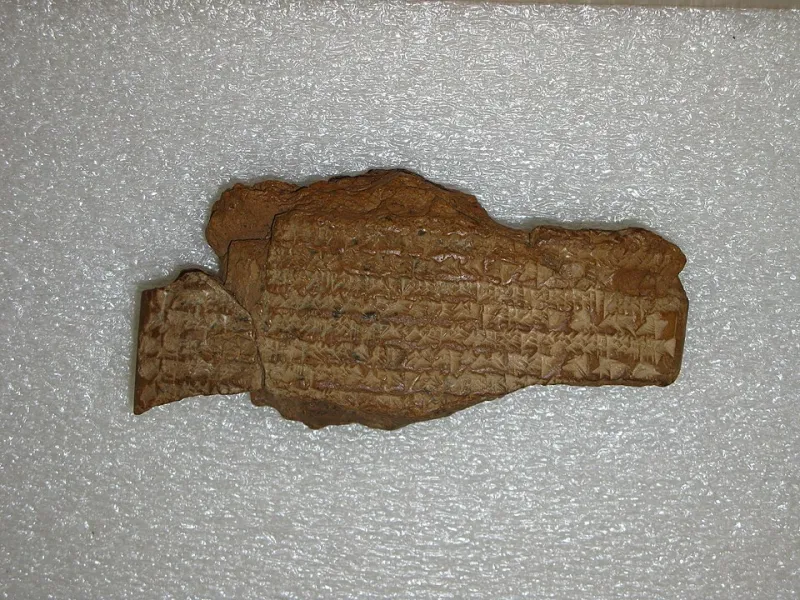
Photo: Unknown, CC0, via Wikimedia Commons
There is a particular comfort in the curse. When a character in a fantasy novel suffers — when their kingdom crumbles, their mind fractures, their bloodline withers — the modern reader is generally offered an explanation that arrives from outside: a witch's hex, a god's punishment, an enchanted object that poisons the bearer. Suffering, in the grammar of contemporary fantasy, is almost always administered. Someone or something must be responsible for delivering it.
This is not how the oldest storytellers understood the world.
The mythological traditions of ancient Mesopotamia — Sumerian, Akkadian, Babylonian — produced some of the earliest sustained narratives in human history, and they operated according to a fundamentally different logic. In those stories, catastrophe was not a sentence handed down by a divine magistrate. It was a horizon that came into view the moment a particular choice was made. Consequence, in Mesopotamia, was not punishment. It was physics.
What modern fantasy has done with that inheritance is worth examining carefully — because the substitution reveals something uncomfortable about how American popular culture prefers to think about failure, responsibility, and the relationship between human beings and the forces that govern their lives.
The Architecture of Ancient Consequence
Consider The Epic of Gilgamesh, the most complete and widely studied of Mesopotamian narrative texts. Gilgamesh, king of Uruk, is introduced as a man of extraordinary gifts and proportionally extraordinary excess. He exhausts his people. He takes what he wants. He is not wicked in a cartoonish sense — he is simply a person whose power has outpaced his wisdom.
When Enkidu, his companion, dies, Gilgamesh does not receive a curse. No divine tribunal convenes to punish him. Instead, the story allows him to experience the natural consequence of having lived as though he were exempt from mortality: he is not. His grief is real, his quest for immortality is understandable, and his failure to secure it is presented not as divine retribution but as the inevitable outcome of being human. The gods are present in this story, but they are not primarily in the business of issuing punishments. They are, more often, architects of the conditions within which human choices play out.
This is a subtle but profound distinction. Mesopotamian divinity was less a moral police force than a structural framework — a set of cosmic conditions, sometimes negotiable, sometimes immovable, within which mortals exercised genuine agency and bore genuine costs.
The myth of Inanna's descent into the underworld operates similarly. Inanna chooses to enter the realm of her sister Ereshkigal. She is stripped of her powers at each of the seven gates — not as punishment, but as the inherent cost of crossing into a domain governed by different laws. The narrative does not moralize. It simply describes what happens when a particular boundary is crossed. The consequence is architectural, not punitive.
How Fantasy Turned Outcome into Hex
Modern fantasy literature — shaped heavily by the Tolkien tradition and its subsequent commercial descendants — inherited a broadly Christian moral framework in which suffering tends to be either redemptive or retributive. The Dark Lord curses the land. The witch hexes the prince. The forbidden artifact corrupts its wielder because corruption is the artifact's purpose, designed by some malevolent intelligence to ensnare the unwary.
This framework is not without its own power. But it does something that Mesopotamian narrative carefully avoided: it externalizes moral failure. When a character's downfall is the result of a curse, the audience is implicitly invited to locate the source of suffering outside the character's essential nature and choices. The corruption came from the ring. The madness came from the witch. The kingdom fell because of an ancient hex placed on the bloodline generations ago.
The character suffers, but the architecture of the story assigns the blame to an external agent. Consequence is transformed into victimhood, and victimhood — however dramatically satisfying — is a fundamentally different moral proposition than accountability.
This shift maps onto something recognizable in contemporary American cultural discourse. There is a persistent tension in this country between two competing frameworks for understanding failure: one that emphasizes systemic and structural causes, and one that insists on individual responsibility. Fantasy, perhaps inadvertently, has developed a third option that satisfies neither camp — the magical explanation, which attributes suffering to a supernatural agent and thereby sidesteps the question of human agency almost entirely.
What Is Lost in the Translation
The cost of this substitution is not merely philosophical. It is, in the most practical sense, a loss of narrative texture.
When consequence is inevitable rather than administered, stories acquire a particular kind of weight. The tragedy of Gilgamesh is not that a god decided to humble him — it is that his own nature, his own hunger, his own refusal to accept limitation, brought him to the edge of the world and left him empty-handed. The audience cannot comfort themselves by blaming the divine antagonist. There is no antagonist. There is only a man and the shape of what he chose.
This is genuinely frightening in a way that curses are not. A curse implies the existence of a cure, a counter-spell, a ritual of reversal. Inevitability offers no such consolation. The Mesopotamian tragic mode understood that some consequences cannot be undone because they were never imposed — they simply became, as naturally as water finding the lowest point in a landscape.
Fantasy fiction that operates within this framework tends to be among the most enduring. Ursula K. Le Guin's Earthsea cycle, for instance, treats magic as a system governed by balance rather than moral reward and punishment. The consequences in those books arrive not because a villain willed them but because the world maintains its own equilibrium, indifferent to human desire. It is no coincidence that Le Guin was deeply influenced by Taoist philosophy — a tradition that, like Mesopotamian mythology, understood consequence as natural law rather than divine verdict.
Reclaiming the Inevitable
What would it look like for contemporary fantasy to return to consequence as inevitability?
It would require, first, a willingness to let characters fail without providing an external agent to blame. It would require stories in which the downfall of a kingdom is traceable not to a hex but to a series of decisions made by people who understood what they were doing, or who refused to understand, and who were undone by the gap between those two states.
It would require, in other words, a certain courage — the courage to write tragedy that does not comfort the reader with a villain, that does not offer the reassurance of magical retribution as proof that the universe is morally supervised.
Mesopotamian mythology was not a comforting tradition. It produced stories in which the gods were capricious, mortality was absolute, and the best a person could hope for was to live well within the conditions they had been given. There was no guaranteed afterlife of reward, no cosmic guarantee that virtue would be recognized. There was only the world, and what you did in it, and what followed from that.
That is a harder story to tell than the curse narrative. It is also, arguably, a truer one — and the oldest literary tradition on earth built its most enduring works upon it. The question for fantasy, in this moment, is whether the genre has the appetite to follow where Gilgamesh once led: not toward retribution, but toward the far more unsettling country of the simply, irreversibly earned.