The Serpent That Swallows Itself: How One Ancient Symbol Became the Blueprint for Every Fantasy Universe
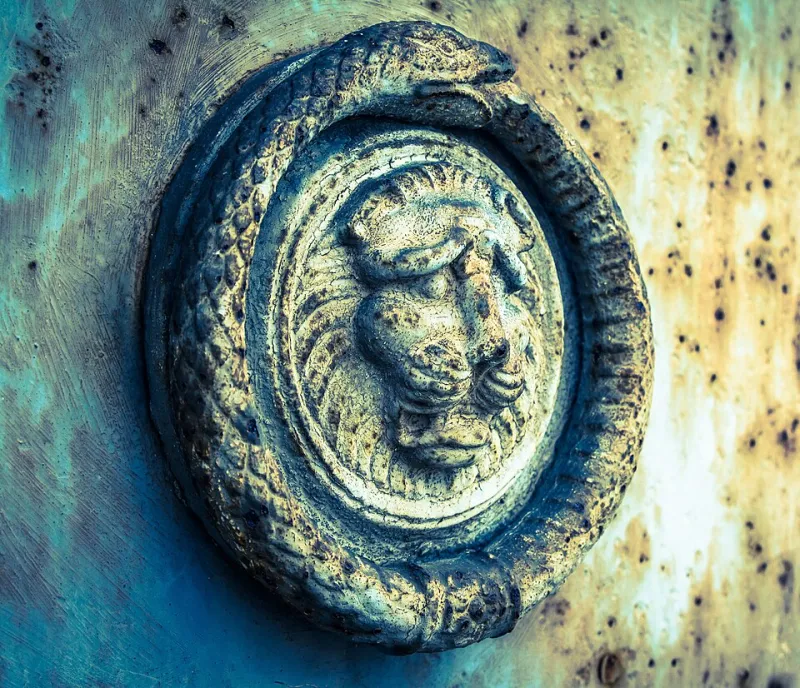
Photo: Swiertz, CC BY 3.0, via Wikimedia Commons
There is a particular kind of vertigo that strikes readers of serious fantasy fiction — the sensation of standing at the edge of a world so vast and so internally consistent that it seems to fold back on itself. Creation myths that echo destruction myths. Magic systems that require sacrifice to generate power. Civilizations that rise precisely because earlier ones fell. That vertigo has a name far older than the genre itself. It is the ouroboros: the serpent consuming its own tail, a symbol so ancient and so geographically widespread that its persistence in modern storytelling cannot be dismissed as coincidence.
It is, in every meaningful sense, the oldest worldbuilding tool humanity ever invented.
A Symbol Without a Single Author
Most symbols can be traced to a point of origin. The ouroboros resists that exercise entirely. Egyptologists have identified its earliest confirmed visual appearance in the Enigmatic Book of the Netherworld, a funerary text found in the tomb of Tutankhamun dating to roughly 1350 BCE. Yet the conceptual architecture it represents — the idea that endings and beginnings are the same event viewed from different positions in time — appears independently across Hindu cosmology, Norse mythology, pre-Columbian Mesoamerican belief systems, and ancient Greek Orphic traditions.
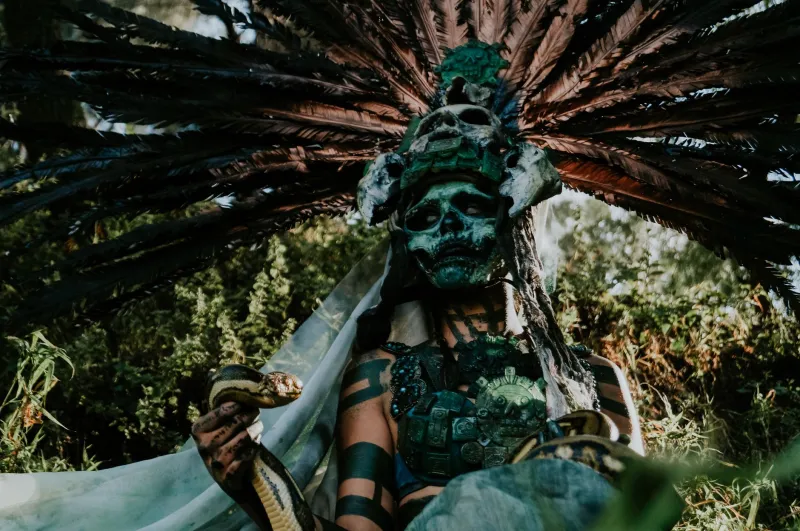
In Hindu cosmology, the world-serpent Shesha coils beneath the cosmos, supporting existence itself, its body forming the boundary between structured reality and the formless void beyond. In Norse mythology, Jörmungandr encircles Midgard so completely that it bites its own tail, and the release of that grip signals not merely catastrophe but the specific catastrophe of Ragnarök — the end that makes a new beginning possible. The Aztec feathered serpent Quetzalcóatl participates in a cosmological cycle in which gods destroy and recreate the world across successive ages, each collapse seeding the next creation.
These traditions did not communicate with one another. They arrived at the same image by independent routes. That convergence demands explanation.
Why the Serpent? Why the Circle?
Anthropologists have long noted that serpents occupy a psychologically distinctive category in human perception. Unlike most animals, they move without limbs, appear and disappear into the earth, shed their skins to emerge apparently renewed, and can exist in states — coiled, still, nearly invisible — that blur the boundary between animate and inanimate. They are creatures of threshold. In nearly every mythology that features them prominently, serpents govern the space between states of being: life and death, order and chaos, the known world and whatever lies beyond its edge.
The circle they form when consuming their own tails amplifies this threshold quality into something cosmic. A circle has no beginning and no end. It cannot be traversed in a straight line. It is, geometrically speaking, a refusal of linearity — and linearity is precisely what most human narratives depend on. By bending the serpent's body into that shape, ancient mythmakers were encoding a specific and radical claim: that the universe does not proceed from point A to point B, but rather curves back on itself in ways that make the distinction between origin and terminus philosophically unstable.
This is not a primitive or naive cosmology. It is, in fact, closer to certain contemporary models of cyclical cosmology in theoretical physics than the linear creation-to-heat-death narrative that dominated Western scientific thought for most of the twentieth century.
Fantasy Worldbuilding and the Recursive Trap
Modern fantasy writers who attempt to construct genuinely complete cosmologies — not merely settings, but worlds with their own metaphysics — tend to rediscover the ouroboros structure even when they are not consciously invoking it.
Consider the structure underlying Robert Jordan's Wheel of Time series, in which the universe literally turns on a wheel, ages succeeding one another in a cycle that makes every triumph temporary and every catastrophe survivable. The Dragon is reborn not because of divine mercy but because the Pattern of existence demands recursive renewal. The imagery is unmistakably ouroborian, and Jordan drew explicitly on Hindu and Norse sources in constructing it.
Or consider the cosmological architecture of Brandon Sanderson's Cosmere, where Shards of a broken divine being distribute power across multiple worlds, and the central tension involves whether those Shards will eventually be recombined — an act that would simultaneously represent completion and annihilation. The system is built on the tension between fragmentation and wholeness, a tension the ouroboros encodes in a single image.
Even science fiction engages the pattern. Frank Herbert's Dune places ecological and political cycles at the center of its universe, with the sandworm — a serpentine creature of enormous power — serving as both the source of the most precious substance in existence and the agent of transformation that makes new life possible. The worm does not merely appear serpentine. It participates in a mythological logic that Herbert spent decades constructing, one in which endings are always also beginnings.
What the Symbol Demands of Storytellers
The ouroboros is not merely decorative. When worldbuilders reach for it — consciously or not — they are committing to a specific set of narrative obligations. A world structured around cyclical recursion cannot offer simple resolution. Its heroes cannot simply win. Every victory must carry within it the seed of the next conflict, because the alternative would be to stop the wheel, to break the serpent's circle, and that act in ouroborian cosmology is not liberation. It is annihilation.
This is why so many of the most ambitious fantasy series resist the satisfying endpoints that casual readers sometimes demand. The story cannot end cleanly because the world it depicts does not end cleanly. The serpent keeps swallowing. The wheel keeps turning. The cycle keeps completing itself and beginning again.
For American audiences weaned on narratives of progress — the frontier, the startup, the comeback story — the ouroboros offers something genuinely disorienting: a cosmological structure in which the question is not where are we going but what will this moment look like when it returns. It is a profoundly different orientation toward time, and the fact that it keeps surfacing in the fiction that resonates most deeply suggests that the disorientation is, at some level, welcome.
The Symbol That Cannot Be Retired
What makes the ouroboros so durable — across Egyptian tombs, Norse eddas, Hindu epics, and the shelves of American fantasy readers — is not its visual elegance, though that is considerable. It is the philosophical work it performs. It gives form to the otherwise unimaginable: the idea that existence is not a line but a loop, that every ending is a kind of mouth, and that the world perpetually feeds on what it has already been.
For a species that builds stories to make sense of a universe it did not design, that image is not merely useful. It is, apparently, necessary. The serpent keeps returning because the question it encodes — what lies at the edge of everything, and what happens when you reach it? — never stops demanding an answer.
And so the worldbuilders keep drawing the circle. The serpent keeps finding its tail. The cosmos, as it always has, keeps beginning again.