The Story That Ends Where It Began: Cyclical Cosmologies and the Future of Fantasy Narrative
Open almost any fantasy novel published in the United States in the past fifty years and you will find, beneath whatever surface variations distinguish it from its neighbors on the shelf, a single structural skeleton: a world in imbalance, a protagonist summoned or compelled to act, a journey toward a confrontation, and a resolution in which the imbalance is corrected. The story ends. The darkness is defeated. The wheel of ordinary life, interrupted by the narrative, resumes its turning.
This architecture is so pervasive that it has ceased to feel like a choice. It feels like the nature of stories themselves. But it is not. It is the particular inheritance of a cosmological tradition — broadly Western, broadly linear, broadly teleological — that understands time as a road with a destination. Other traditions understand time as something else entirely, and the stories those traditions generate are structured accordingly. What would happen to fantasy fiction if it genuinely absorbed those structures is not merely an academic question. It is the most interesting creative question the genre has not yet seriously asked.
The Wheel That Does Not Stop: Hindu Cosmological Time
Hindu cosmological tradition operates on a scale of time that makes the entire span of recorded human history appear as a brief flicker. The concept of the Yuga — the cosmic age — describes a vast cycle of four epochs through which the universe passes: from the Satya Yuga, an age of spiritual perfection, through progressively degraded periods, to the Kali Yuga, the current age of conflict and material preoccupation, before the cycle resets entirely with a new Satya Yuga.
Within this framework, the Mahabharata — one of the foundational epic narratives of the Hindu tradition — does not conclude with a simple victory. The Pandavas triumph in the Kurukshetra War, but the world they inherit is already the Kali Yuga. Their victory is real and meaningful, but it does not arrest the cosmic decline. The universe continues its rotation. The correct response to this knowledge, according to the text's own philosophical framework, is not despair but a particular kind of detached engagement — acting rightly without attachment to outcomes that the cycle will eventually reclaim.
For fantasy fiction, this represents a genuinely alien narrative proposition. A story structured around Hindu cosmological time would not end with the evil defeated and the world restored. It would end with the protagonists having acted correctly within an epoch that continues to deteriorate — and that framing would demand a different kind of heroism than the genre currently celebrates.
Dreamtime and the Narrative That Is Always Occurring
Indigenous Australian concepts of the Dreaming — often inadequately translated as the Dreamtime — present an even more radical challenge to linear narrative. The Dreaming is not a past era. It is not a mythological prehistory that explains the present. It is an ongoing condition of reality in which the ancestral beings who shaped the world continue to act, whose movements are encoded in the landscape, and whose stories are not completed but perpetually enacted.
In this framework, a narrative does not conclude. It participates. The telling of a story is not a recollection of something that happened; it is a renewal of something that is always happening. The landscape itself is the text, and moving through it is a form of reading that is also a form of authorship.
Translating this cosmological structure into fantasy fiction would require abandoning not just the linear plot arc but the very concept of narrative completion as a form of meaning. A fantasy world built on these principles would be one in which the protagonist's actions do not resolve the world's condition but maintain it — in which the heroic act is not the great disruption but the careful, ongoing participation in a pattern that must be perpetually renewed. Victory, in such a world, looks indistinguishable from continuity.
The Mesoamerican Calendar and the Weight of Return
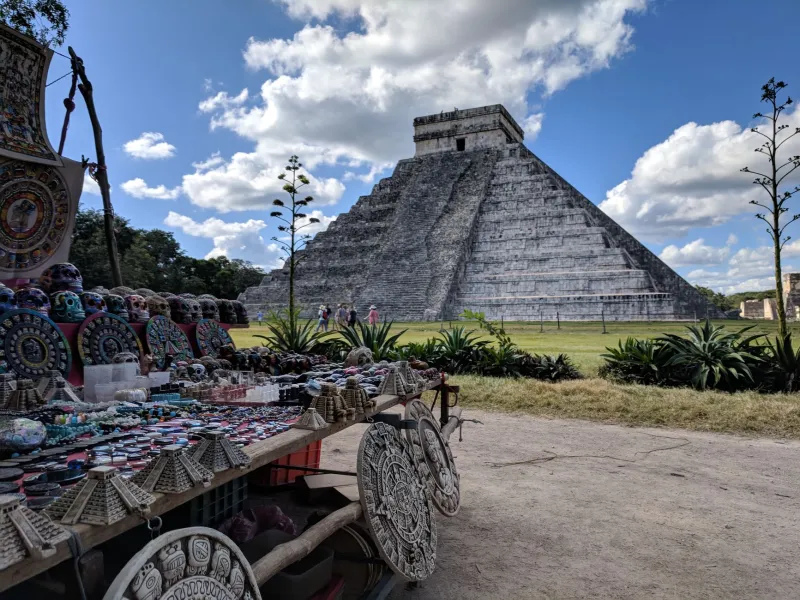
Mesoamerican civilizations — Aztec, Maya, and their predecessors — developed cosmological systems in which the current world is not the first world but one iteration in a sequence of creations and destructions. The Aztec concept of the Five Suns describes four previous worlds, each destroyed by a different catastrophe, before the current age was established through the sacrifice of the gods at Teotihuacan. This world, too, is understood to be temporary. The calendar systems that governed Mesoamerican civic and religious life were not merely organizational tools. They were instruments for tracking the approach of the current cycle's termination.
The narrative implications of this cosmology are profound. In a world structured by Mesoamerican cyclical time, the hero's journey does not prevent the end of the world. It delays it — and that delay is understood to require ongoing sacrifice, not a singular heroic act. The protagonist of such a story is not a savior in the Western sense but a participant in a maintenance ritual whose success is always temporary and whose failure is always eventual.
This framework generates a fundamentally different relationship between the protagonist and the concept of victory. The question is not whether the darkness can be defeated but how long the light can be sustained — and what price is worth paying for each additional cycle of continuation.
What American Fantasy Audiences Stand to Gain
American readers have been educated, largely without realizing it, into a specific set of narrative expectations. The story should progress. The protagonist should grow. The ending should represent a meaningful departure from the beginning. These expectations are not universal. They are cultural inheritances, and like all cultural inheritances, they both enable and constrain.
Fantasy fiction that genuinely adopts cyclical cosmological frameworks would offer American audiences something genuinely disorienting — and disorientation, in the best literary sense, is the precondition for the kind of perspective shift that great storytelling can produce. A protagonist who acts well knowing that the world will require saving again, and again, and again — not as a franchise opportunity but as the fundamental condition of existence — is a different kind of hero than the genre has learned to celebrate.
The moral seriousness of that proposition is considerable. In a cultural moment when the idea of permanent solutions to large-scale problems has become difficult to sustain with a straight face, the cyclical cosmologies of non-Western traditions offer not pessimism but a different form of courage: the courage to act well within a pattern that will outlast the action.
The Revolution Hiding in Plain Sight
The tools for this transformation are not exotic or inaccessible. The Mahabharata has been available in English translation for more than a century. The scholarship on Mesoamerican calendrical systems is extensive and increasingly accessible to general readers. Indigenous Australian storytelling traditions, though properly requiring engagement with living communities rather than merely academic texts, have been discussed in serious literary and anthropological contexts for decades.
What has been missing is not access but willingness — the willingness to accept that a story without a final resolution is not an incomplete story but a different kind of story, one that may be capable of saying things about human experience that the linear quest narrative, for all its power, structurally cannot. The wheel turns. The hero acts. The world continues. And in that continuation, if the storytelling is honest enough, something true about living in time becomes visible that no amount of linear progress can reveal.