Sacred Wreckers: How Ancient Demons of Disorder Were Robbed of Their Cosmic Purpose
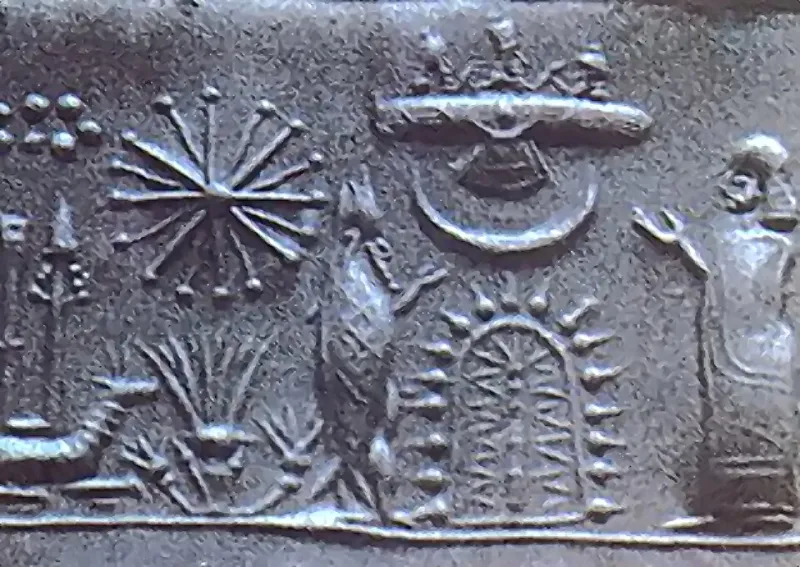
Photo: The original uploader was IronyWrit at English Wikipedia., Public domain, via Wikimedia Commons
There is a peculiar poverty at the heart of how modern fantasy handles its villains. Walk through the antagonist gallery of nearly any bestselling fantasy series, any blockbuster film rooted in ancient mythology, any tabletop adventure published in the last three decades, and you will find a recurring figure: the demon of chaos, the dark lord of destruction, the ancient evil that simply wants to unmake the world. The motivation is thin. The philosophy is thinner. And the tragedy is that the source material — the actual mythological traditions from which these figures were drawn — offered something far richer, far stranger, and far more philosophically demanding.
The ancient Near East and the Indian subcontinent produced two of history's most sophisticated cosmological systems. Both placed destructive, destabilizing supernatural beings at the center of their mythologies. Both assigned those beings a role that defies easy categorization as evil. And both have been systematically misread by a fantasy tradition that inherited their imagery while discarding their meaning.
The Mesopotamian Chaos That Was Never Simply Chaos
When scholars and storytellers reach into the Mesopotamian archive, they most often retrieve Tiamat — the primordial salt-water dragon whose body, according to the Enuma Elish, becomes the architecture of the known world. But Tiamat's story is frequently told as a straightforward defeat of chaos by order, a template for every dragon-slaying narrative that followed. What gets omitted is the theological weight of what Tiamat represented before her death.
Tiamat was not chaos in the modern sense — not randomness, not entropy, not simple destructive malice. She was the undifferentiated potential from which all structure would eventually emerge. Her children, the first gods, were born from her substance. The cosmos was, in a meaningful sense, her. When Marduk kills her and builds the world from her body, the text does not present this as the elimination of evil. It presents it as a transformation — a necessary and violent reorganization of something that could not remain in its original form if the ordered world was to exist.
The gallû demons of Sumerian and Babylonian tradition operate under a similar logic. These beings — who famously descend into the underworld to escort the goddess Inanna back to the land of the living — are not evil in any straightforward sense. They are functionaries of a cosmic system, agents of the boundary between life and death. They follow rules. They fulfill obligations. Their terror is procedural, not malicious. A fantasy tradition that converted figures like these into straightforward monsters lost the entire point: that the most frightening forces in the universe are not the ones that operate outside the rules, but the ones that enforce rules too absolute for human comfort.
The Asuras and the Problem With Winning
If Mesopotamian traditions offer a portrait of destruction as cosmic function, Hindu mythology presents something even more philosophically disorienting: a class of beings — the asuras — whose relationship to the gods is so entangled that the boundary between divine and demonic becomes almost meaningless.
The asuras are typically translated into English as demons, and in the popular imagination — including in American pop culture, which has absorbed Hindu imagery largely through the filter of Western fantasy tropes — they function as the straightforward enemies of the devas, the gods. But this reading collapses a distinction that Hindu theological tradition spent centuries carefully elaborating. In the oldest layers of the Rigveda, the word asura is actually applied to certain devas as a mark of power and authority. The great god Varuna is called an asura. The division between the two categories is not original — it is the product of a long cosmological argument about the nature of power itself.
More critically, the asuras in later tradition are not simply evil. Many of them are depicted as supremely disciplined, philosophically sophisticated, and capable of extraordinary devotion. Figures like Prahlada — technically an asura by birth — become models of spiritual virtue. Bali, the asura king, is remembered in Kerala's Onam festival as a beloved ruler whose reign was characterized by justice and abundance. The god Vishnu tricks him into giving up his kingdom not because Bali is corrupt, but because the cosmic order requires that the devas hold dominion during this particular age. The tragedy is structural, not moral.
What this means, in practical terms, is that the asuras lose not because they are evil but because the universe is arranged in cycles — and it is currently someone else's turn. That is a genuinely unsettling cosmological premise. It implies that the winners of any cosmic conflict are not necessarily the righteous, only the timely. Fantasy almost never goes there.
What Happens When Writers Restore the Ambiguity
The question is not merely academic. When contemporary writers do return to these traditions with genuine curiosity — when they allow their destructive supernatural figures to carry the philosophical weight the original myths assigned them — the results tend to be the most memorable work in the genre.
Consider what becomes available when a demonic antagonist is not simply malevolent but cosmically necessary. The conflict shifts. The hero's victory becomes morally complicated rather than morally clean. If the force of disruption serves a function — if its suppression creates imbalance rather than resolving it — then defeating it is not a triumph but a transaction, one with costs that will eventually come due. This is the kind of storytelling that the Mesopotamian and Hindu traditions were built to support. It is also, not coincidentally, the kind of storytelling that tends to produce the most durable myths.
The asura Vritra, whose defeat by the god Indra is celebrated as a great victory, is simultaneously the being whose death released the cosmic waters and allowed agriculture to flourish. Indra kills a monster and becomes a murderer in the same moment. The Mahabharata spends considerable energy worrying about this. Modern fantasy, by and large, does not.
Disruption as Architecture
What both the Mesopotamian and Hindu traditions understood — and what fantasy worldbuilding has largely failed to absorb — is that disruption is not the opposite of order. It is one of its mechanisms. The forces that tear things apart make room for new structures. The demons that challenge the gods force the gods to evolve. The chaos that precedes creation is not the enemy of the cosmos; it is its raw material.
This is not a comfortable idea. American popular culture, in particular, has a deep investment in the notion that evil is identifiable, that its defeat is unambiguous, and that the world is better once the dark lord is gone. These assumptions are understandable — they are emotionally satisfying, and they map onto certain genuine moral intuitions about harm and protection.
But they are not the only framework available. They are not even the oldest one. The traditions that gave us Tiamat, the gallû, Bali, and Vritra were asking harder questions — about whether destruction can be sacred, about whether the beings we call demons might be doing work the cosmos requires, about whether victory over chaos is always something worth celebrating.
Fantasy worldbuilding that ignores those questions is not simply missing historical nuance. It is choosing a smaller, less honest universe — one where the wreckers are just wreckers, and the rubble is just rubble, and nothing that breaks was ever sacred to begin with.