What Your Name Destroys: The Ancient Logic of Naming Magic That Fantasy Has Never Truly Grasped
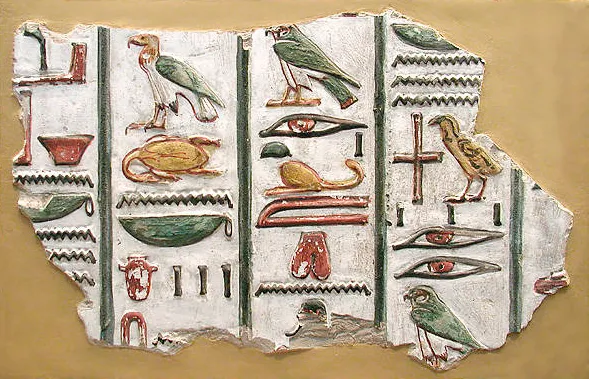
Photo: unknown Egyptian scribe, Copyrighted free use, via Wikimedia Commons
There is a moment familiar to nearly every reader of modern fantasy: a character discovers the true name of a dragon, a demon, or a god, speaks it aloud, and suddenly commands the creature's obedience. The scene is dramatic. It is also, in nearly every iteration, a profound misreading of what ancient cultures actually understood names to be. The true name in fantasy is a password. In mythology, it was something closer to a soul.
The distinction is not merely academic. It reaches into the foundational question of what a self is, what language does to the world, and why certain ancient peoples treated the act of naming with the gravity that modern cultures reserve for surgery or legislation. To understand naming magic as it actually existed in religious and cultural practice is to encounter an idea so strange and so structurally sound that it makes most fantasy treatments of the subject look like a child playing with a live wire.
Egypt: The Name as the Living Self
In ancient Egyptian theology, the human being was not a unified soul housed in a body. It was a composite of distinct metaphysical components, among them the ren—the name. The ren was not a label applied to a person from outside. It was understood as an intrinsic part of what made that person exist at all. A person whose name was destroyed was not merely forgotten. They were, in a meaningful cosmological sense, unmade.
This belief had direct and documented consequences. When the pharaoh Akhenaten's religious reforms were reversed after his death, those who sought to erase his legacy did not simply demolish his monuments. They systematically chiseled his name from every surface they could reach. This was not vandalism in the ordinary sense. It was understood as an act of ontological erasure—an attempt to excise him from existence itself, not just from memory. The same logic applied in reverse: to speak the name of the dead during funerary rites was to sustain them, to feed their continued being in the afterlife.
Consider what this implies. The name is not a reference to a thing. It is a constituent part of the thing. To know it fully is not to hold a key—it is to hold a fragment of the being itself. That is a categorically different kind of power than what fantasy typically portrays, and it carries categorically different ethical weight.
Hebrew Tradition: The Name That Cannot Be Spoken
The Hebrew tradition offers an equally radical but differently structured understanding. The unpronounceable name of God—the Tetragrammaton, the four-letter name rendered in English approximation as YHWH—was not kept secret because it was a password to divine power. It was treated with extreme reverence because the name and the divine presence it designated were understood to be inseparable. To speak the name carelessly was not merely disrespectful. It was to handle something of infinite ontological density without the preparation or authority to do so safely.
This logic extends into the Kabbalistic tradition, where the act of creation itself is understood as a linguistic event. God speaks, and worlds come into being. The letters of the Hebrew alphabet are not symbols representing sounds. They are understood, in certain schools of thought, as the structural grammar of existence—the actual material from which reality is woven. In this framework, naming is not metaphor. It is participation in the original creative act.
The Golem legend, which has found its way into fantasy and science fiction in various forms, gestures at this understanding, but rarely follows it to its source. The creature animated by the word emet—truth—written on its forehead, and destroyed by the erasure of the first letter to produce met—death—is a story about language as the literal boundary between being and non-being. Most retellings treat this as a clever plot mechanism. The original tradition understood it as a cosmological statement.
Aboriginal Australia: Country, Kinship, and the Name That Holds the World
The Aboriginal Australian understanding of naming operates along a different axis entirely, but arrives at a comparable conclusion about the weight of what names do. Within the framework of the Dreaming—the complex, non-linear cosmological order that underlies and pervades the physical world—names are not assigned to places or beings after the fact. They are part of the act of creation. The Ancestor beings who shaped the landscape during the Dreaming did so, in part, through song and naming. To know the name of a place, the song that belongs to it, and the story that created it is to hold a form of custodianship over that place's continued existence.
This is naming not as identification but as relationship—as ongoing responsibility. The name binds the one who holds it to the thing named, creating an obligation that is simultaneously spiritual, ecological, and social. When certain names are restricted, spoken only in specific ceremonial contexts or by those with the appropriate kinship authority, it is because the name carries consequences. Using it without that authority is not merely a breach of etiquette. It is a disruption of a living system.
What Fantasy Misses—and What It Loses
Modern fantasy's treatment of naming magic tends to collapse all of this into a single mechanic: the true name grants control. This is, in a sense, the most superficial layer of the idea—the power aspect, stripped of the ontological architecture that gives it meaning. What is lost in this reduction is considerable.
First, the moral dimension disappears. If a name is part of a being's self, then to seize it is not a clever tactical move—it is a form of violation, closer in its implications to possession or enslavement than to finding a hidden switch. Stories that treat naming magic as a neutral tool available to any sufficiently clever protagonist are, without realizing it, narrating something closer to an atrocity.
Second, the vulnerability is inverted. In Egyptian belief, it is not only the names of others that carry power—your own name is your exposure. To exist with a name is to exist with a surface that can be attacked. This creates a kind of existential fragility that fantasy rarely explores, because it requires the protagonist to be genuinely, metaphysically at risk in a way that goes beyond physical peril.
Third, the creative dimension is abandoned entirely. If names are the grammar of existence, then naming is an act of world-making. A character who names something is not cataloguing it—they are, in some sense, bringing it further into being. The responsibility attached to that act is enormous, and narratively rich in ways that the control-through-true-names trope never approaches.
The Story Waiting to Be Told
There is a version of fantasy fiction that takes these ideas seriously—where the act of naming a child is understood as a cosmological event, where the erasure of a name from a record is a form of killing, where a character who learns to speak the names of things fluently is not a wizard accumulating power but a person assuming terrifying responsibility for the fabric of the world around them.
That story has not been written in any mainstream way. The mythological traditions that could inspire it are not obscure. Egypt, Hebrew scripture, and Aboriginal Australia are not unknown to the culture industries that produce fantasy at scale. The material is available. What has not yet arrived is the willingness to let names be as heavy as the ancient world understood them to be—to let language do to a fictional world what the oldest human traditions always believed it did to the real one.
Names, in those traditions, were not labels. They were load-bearing walls. Pull the wrong one, and the whole structure comes down.