Keepers of the In-Between: How Threshold Spirits Became Mythology's Most Overlooked Architects
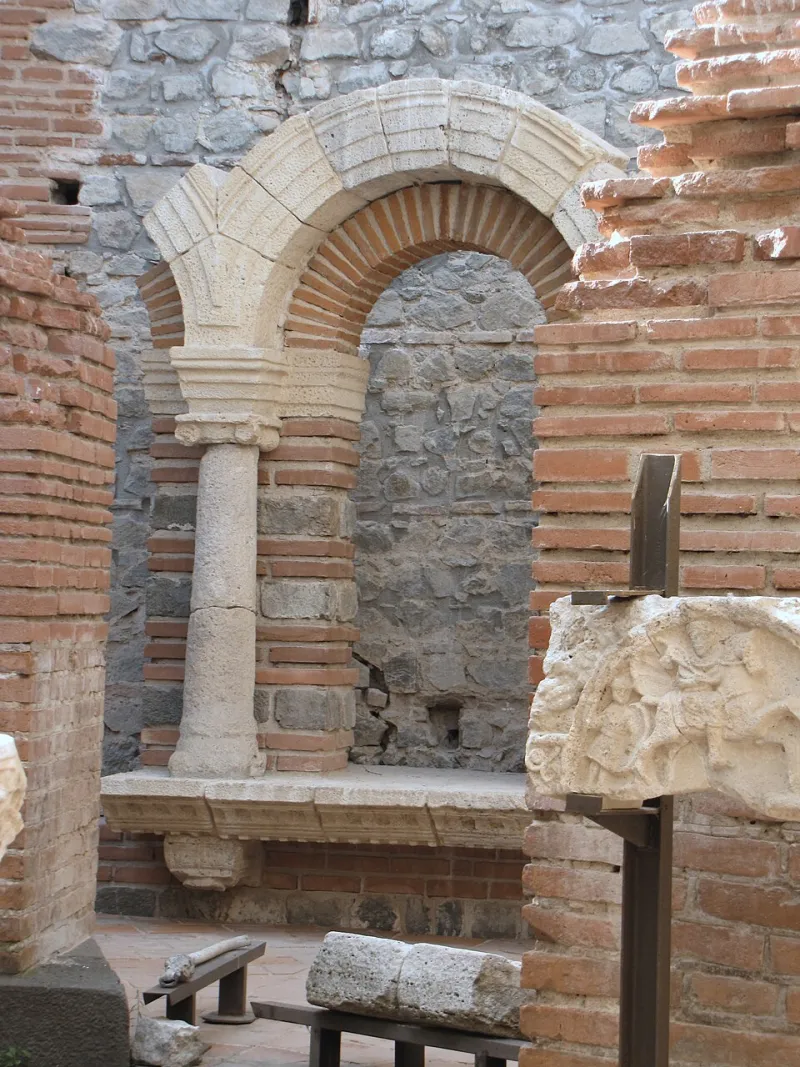
Photo: Institute for the Study of the Ancient World, CC BY 2.0, via Wikimedia Commons
There is a moment, familiar to anyone who has stood in a doorway at dusk unable to decide whether to step inside or remain on the porch, when the world seems to hold its breath. Ancient peoples did not regard this sensation as mere indecision. They understood it as a signal: you are standing in a place that belongs to something else. Something that watches, mediates, and judges. Something that does not appear in the grand narratives of gods and heroes, but without which those narratives would have no architecture to stand upon.
These are the threshold guardians — the liminal spirits embedded in the connective tissue of world mythology — and fantasy fiction has rendered them almost entirely invisible.
What "Liminal" Actually Means, and Why It Matters
The word liminal derives from the Latin limen, meaning threshold. In the study of mythology and anthropology, liminality describes the condition of existing between defined states: between night and day, between the living and the dead, between the known settlement and the wild beyond its fence. Anthropologist Arnold van Gennep, writing in the early twentieth century, identified this in-between condition as one of the most psychologically charged territories in human experience. Later, Victor Turner expanded the concept to describe entire social phases in which ordinary rules are suspended and transformation becomes possible.
But mythology did not wait for academic frameworks to recognize the power of the threshold. Cultures across every inhabited continent had already been populating these in-between zones with beings of remarkable complexity for thousands of years.
Janus and the Roman Architecture of Passage
Roman mythology offers perhaps the most formally developed threshold deity in the Western tradition. Janus — the two-faced god of beginnings, gates, and transitions — was not a minor curiosity. He was invoked before any other deity at the start of religious ceremonies, a protocol that acknowledged his role as the entity through whom all things must first pass. His two faces, gazing simultaneously into the past and the future, were not a symbol of duplicity but of comprehensive awareness: the guardian who sees both sides of every threshold at once.
What is striking about Janus is his administrative function. He did not wage war, seduce mortals, or hurl lightning. He managed the infrastructure of the sacred world — the doors, the archways, the moments of crossing. He was, in essence, the operating system through which divine and human activity ran. Yet in the vast landscape of fantasy fiction inspired by Roman mythology, Janus is almost never encountered. The generals and the emperors appear. The god who made their passages possible does not.
Hecate at the Crossroads: Where Three Roads Meet
Greek mythology placed Hecate at every crossroads — the triple-formed goddess of magic, the moon, and the spaces between choices. Crossroads in the ancient world were not merely navigational intersections. They were understood as places where the membrane between the living world and the underworld grew thin, where spirits gathered, where decisions made could not be easily unmade. Hecate presided over all of this with a torch in each hand, illuminating the dark not to eliminate it but to reveal what it contained.
She was propitiated with offerings left at crossroads on the last night of each month — meals called deipna Hekates, the suppers of Hecate — by ordinary households seeking safe passage through uncertain times. This was not the religion of temples and priests alone. It was the religion of people who walked roads at night and understood that something ancient attended those walks.
Fantasy fiction has occasionally borrowed Hecate's name, but it has rarely borrowed her function. She appears as a witch-goddess, a source of dark power, an antagonist with dramatic flair. What she almost never appears as is what she actually was: a guardian whose presence at the crossroads was fundamentally protective, a figure whose liminality served the community rather than threatening it.
The Orishas of the Threshold: Eshu and Legba
In the Yoruba tradition and its diaspora expressions across the Americas — particularly in Candomblé, Santería, and Vodou — the threshold guardian takes the form of Eshu (or Exu) and his counterpart Legba. These are the entities who stand at the crossroads between the human world and the divine, and no communication between the two realms can occur without their permission and participation. They are invoked first, before any other spirit, because they hold the keys to every conversation that follows.
Legba in particular, often depicted as an old man leaning on a cane at the crossroads, embodies the paradox of the threshold guardian with unusual clarity. He appears weak but is foundational. He appears peripheral but is absolutely central. Without Legba, the elaborate architecture of the Vodou spirit world — the lwa, the ceremonies, the healing traditions — would have no point of entry. He is not the most dramatic figure in the pantheon. He is the most necessary one.
This is the quality that fantasy fiction consistently undervalues: the necessary over the dramatic.
The Twilight Beings of Japanese Mythology
Japanese folklore populates the liminal hours — particularly tasogare, the twilight period whose name once translated roughly as "who are you?" — with spirits of uncertain identity and unpredictable intent. The ōmagatoki, or "the time of great calamity," referred to dusk and dawn as periods when the boundary between worlds loosened and encounters with the supernatural became far more likely. Shrines were built at the edges of villages, not their centers, precisely because the threshold demanded its own sacred space.
The dosojin, stone guardian deities placed at roadsides and mountain passes, served a function remarkably similar to Hecate and Legba: they protected travelers at the precise moments of transition, the points where one territory ended and another began. They were not heroic figures. They were structural ones.
What Fantasy Loses by Ignoring Them
The dominance of the chosen-one narrative in fantasy fiction has produced worlds that are, architecturally speaking, quite thin. There is a dark lord. There is a hero. There is a prophecy. The machinery of the cosmos exists primarily to deliver these two figures into collision. What is absent is the vast middle ground — the spirits, guardians, and intelligences that make a world feel genuinely inhabited rather than merely staged.
Threshold guardians, when taken seriously, do something that chosen heroes cannot: they distribute sacred significance across the entire landscape of daily life. When every doorway might be attended, when every crossroads carries the memory of something ancient, when twilight is understood as a managed transition rather than simply a lighting condition, the world itself becomes mythologically dense. Ordinary people moving through ordinary spaces become participants in a cosmology, not merely witnesses to a hero's journey.
This is the promise that mythology extended to its believers, and it is a promise that fantasy fiction has largely declined to honor.
Building Worlds at the Threshold
For writers, game designers, and worldbuilders working in the fantasy space, the threshold guardian tradition offers something genuinely rare: a structural principle for cosmology that does not depend on escalating power levels or apocalyptic stakes. A world in which liminal spirits are taken seriously is a world in which the act of crossing a river, entering a new city, or standing at a fork in the road carries genuine weight — because something real and ancient attends those crossings.
The mythological record is extraordinarily generous in this regard. From the Roman Lares Compitales who guarded crossroad shrines, to the Slavic domovoi who presided over the threshold between home and wilderness, to the West African and diaspora traditions centered on Eshu and Legba, the materials for richer, stranger, and more psychologically resonant worldbuilding are already assembled. They have been waiting, quite patiently, at the edge of the door.
The only thing required is the willingness to step through.