Hammered Into Myth: The Divine Smiths That Fantasy Worldbuilding Left at the Anvil
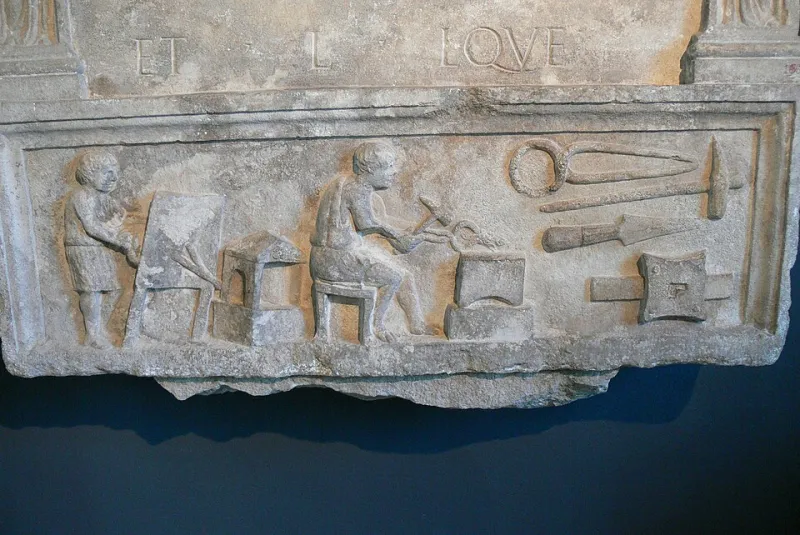
Photo: Wolfgang Sauber, CC BY-SA 3.0, via Wikimedia Commons
There is something deeply human about the image of a god standing before a forge. Sweat-slicked, surrounded by the roar of fire and the ringing percussion of hammer on metal, this figure does not conjure power from thin air — they make it. They shape it, temper it, and pay for it in time and effort. Yet despite the extraordinary richness of divine smith mythology across world cultures, contemporary fantasy literature has largely chosen to look the other way. Magic systems built on gesture and incantation proliferate across bestseller lists, while the gods who built the weapons of the heavens remain gathering dust in the back rooms of mythological scholarship.
This is not a minor oversight. It is a structural choice — one with significant consequences for how fantasy engages with themes of creation, labor, and the relationship between human skill and divine power.
The Global Forge: A Tradition Too Large to Ignore
The breadth of smith god mythology is staggering once one begins to map it. Hephaestus, the Greek god of the forge, fashioned the armor of Achilles, the chains that bound Prometheus, and the golden automatons that served as his assistants — arguably the ancient world's first conception of artificial intelligence. His Roman counterpart, Vulcan, lent his name to the volcanic landscape of Italy and remains embedded in the English language every time we describe a sudden eruption of force.
In Norse tradition, it was not the gods themselves but the dwarven smiths — working under divine mandate — who produced Mjolnir, Gungnir, and the binding ribbon Gleipnir that restrained the wolf Fenrir. The craftsmanship embedded in these objects was itself a form of mythological power: the making was the magic.
Move further east and the tradition deepens. Goibniu of Irish mythology presided over a divine forge and brewed the ale of immortality for the Tuatha Dé Danann. Ilmarinen, the eternal smith of Finnish Kalevala tradition, forged the Sampo — a mysterious artifact of inexhaustible abundance whose true nature has occupied scholars for centuries. In Yoruba tradition, Ogun is not merely a god of iron but a complex patron of all who work with metal: warriors, surgeons, engineers, and mechanics. His domain spans the sacred and the industrial with remarkable fluency, a quality that has made him one of the most persistently relevant deities in the African diaspora, worshipped across West Africa, Cuba, Brazil, and communities throughout the United States.
Kovač traditions in Slavic folklore, the Japanese deity Ame-no-Mahitotsu associated with metalworking and the single divine eye, and the Aztec Xiuhtecuhtli — lord of fire and the forge's heat — all reinforce the same thesis: that humanity, across every continent and era, understood the act of skilled making as something divine.
Why Fantasy Turned Away
The question worth sitting with is not simply that modern fantasy neglected divine smiths, but why.
Part of the answer lies in the gravitational pull of Tolkien's legacy, which, for all its extraordinary craft, drew heavily from Northern European sources and filtered divine power primarily through elven mystery and wizardly abstraction. The forge exists in Middle-earth — Celebrimbor's rings, the reforging of Narsil — but it operates at the margins of the narrative. Magic in Tolkien's world is ultimately a property of being, not of labor.
The broader fantasy genre that followed largely inherited this bias. Sorcery became the genre's default currency of power: innate, inherited, and fundamentally disconnected from the physical world of work. A character either has magic or they do not. The notion that power might be earned through the accumulation of skill, through years at an anvil, through a deep and intimate knowledge of material properties — this idea never fully took hold in the mainstream.
There is also a cultural dimension worth naming directly. In the American context, craft labor has long occupied an ambiguous position in the cultural imagination. The industrial revolution severed many communities from a direct relationship with skilled making, and popular entertainment has tended to romanticize either the purely mystical or the purely technological, rarely the liminal space between them where the forge has always lived.
What Gets Lost Without the Smith
The absence of smith gods from fantasy worldbuilding is not merely a gap in representation. It is a gap in meaning.
Divine smith mythology consistently encodes a set of ideas that are genuinely radical within the genre. First among these is the concept that creation carries cost. Hephaestus does not wave his hand and produce Achilles' shield — he labors over it, and the text of the Iliad devotes considerable space to describing every detail of that labor. The shield's value is inseparable from the effort required to make it. This is a fundamentally different relationship between power and consequence than most fantasy magic systems permit.
Second, smith gods are almost universally associated with transformation rather than creation from nothing. Metal must be found, extracted, smelted, and shaped. The smith works with the material world rather than overriding it. This places divine smithcraft in an interesting philosophical position: it is simultaneously humble and extraordinary, constrained by physical reality yet capable of producing objects of transcendent power.
Third — and perhaps most provocatively — many smith gods occupy marginal social positions within their own pantheons. Hephaestus is lame and frequently mocked. Ogun is associated with the dangerous edges of civilization, the bush and the battlefield. Ilmarinen is a craftsman, not a king. These are not gods of pure authority. They are gods of utility, and their mythological complexity reflects the social ambiguity of the skilled worker across many cultures: essential, respected, and yet somehow never quite at the center of power.
Fantasy worldbuilding that incorporated these figures seriously would be forced to reckon with questions the genre rarely asks. What does it mean when the most powerful artifacts in your world are products of labor rather than gifts of fate? What happens to a magic system when its rules are derived from metallurgy and material science rather than from bloodlines and prophecy?
The Path Back to the Forge
A handful of contemporary works have gestured toward this territory. Brandon Sanderson's Mistborn series encodes its magic systems with mechanical specificity that owes something to the logic of craft. Patrick Rothfuss's The Name of the Wind treats the acquisition of skill as genuinely meaningful, even if it does not invoke divine smiths directly. But these remain exceptions, and none has yet placed a smith deity — in all their mythological complexity — at the center of a fantasy narrative.
The opportunity is extraordinary. A fantasy world in which the gods of creation are not distant and abstract but present, working, bound to the same physical laws as the metals they shape — such a world would feel radically grounded. It would ask its readers to think about power differently, to locate the sacred not in the bloodline or the prophecy, but in the callus, the learned eye, the knowledge of when the metal is ready.
The divine forge has been waiting. The embers have not gone cold. What the genre needs now is a writer willing to pick up the hammer.