The Living Debt: How African and Asian Ancestor Traditions Reveal What Fantasy Gets Catastrophically Wrong About the Dead
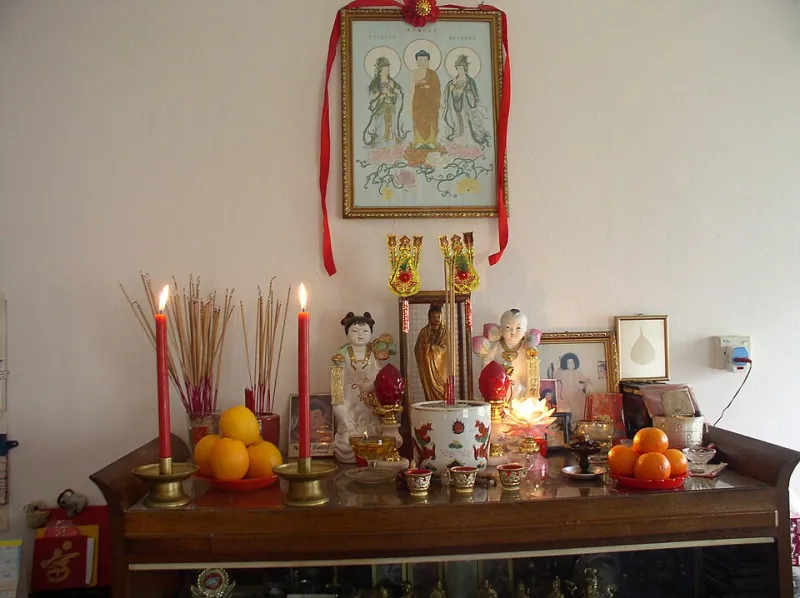
Photo: User:Sampuna at en:wikipedia, Public domain, via Wikimedia Commons
There is a peculiar cruelty embedded in how mainstream fantasy fiction handles its dead. Raise them as skeletal soldiers. Bind them as spectral informants. Banish them when their narrative usefulness expires. The dead in most fantasy worlds exist to serve the living — or to threaten them — and rarely anything in between. What these stories almost never imagine is something far older and far stranger: a world in which the dead are owed something.
That obligation, felt across millennia and across continents, is the foundation of ancestor veneration traditions in sub-Saharan Africa, China, Japan, India, and dozens of other cultures that fantasy worldbuilding has consistently underestimated. To engage seriously with these traditions is to discover not merely an alternative magic system, but an entirely different moral architecture — one in which death does not sever relationship, it deepens it.
The Ancestor Is Not a Ghost
The first error fantasy makes is categorical. Western horror and fantasy inherited a particular image of the lingering dead: the ghost, a figure defined by incompleteness, by unfinished business, by the tragedy of remaining when one ought to have departed. The ghost haunts because something went wrong. It is, at its core, an aberration.
In Yoruba tradition from West Africa, the egungun — the collective ancestral spirit — is nothing of the sort. The ancestors are not failed departures. They are successful transformations. They have crossed into a realm of heightened awareness and returned, through ceremony and invocation, to participate in the community's ongoing life. The egungun masquerade, in which costumed figures embody ancestral presence during festivals, is not theater in the Western sense. It is a genuine interface between worlds, a structured moment of permeability that the community actively maintains.
The distinction matters enormously for worldbuilding. A ghost is a problem. An ancestor is a relationship. One demands resolution; the other demands maintenance.
Reciprocity as Cosmological Law
Chinese ancestor veneration, practiced in various forms across thousands of years and still present in contemporary Chinese American households throughout cities like San Francisco and New York, operates on a principle that fantasy almost never dramatizes: reciprocity across the boundary of death.
The living provide offerings — food, incense, paper representations of goods — because the ancestors require sustenance in their realm, just as the living require guidance and protection in theirs. Neither party is self-sufficient. The relationship is not charity extended downward from the living to helpless shades, nor is it supplication directed upward toward omnipotent spirits. It is an exchange between parties who each possess something the other needs.
This cosmological mutuality would be extraordinary material for a fantasy world. Imagine a society whose economy is partially organized around ancestral debt — where a merchant family's prosperity is understood as a gift from deceased grandparents, and where failing to honor those grandparents carries not merely spiritual but social and financial consequences. Imagine a legal system that must account for ancestral claims on land, on inheritance, on justice. These are not fantasy conceits. They are simplified versions of frameworks that actually governed real human societies for centuries.
The Ancestor as Moral Witness
In many Indian traditions, particularly within the Shraddha rituals of Hinduism, the pitrs — the ancestors — are understood as a category of being with specific cosmic standing. They occupy one of the three debts (rina) that every person is born carrying: obligations to the gods, to the sages, and to the ancestors. The ritual feeding of ancestors during Pitru Paksha, the annual fortnight of ancestral observance, is not optional sentiment. It is the discharge of a genuine liability.
What makes this spiritually complex is the moral dimension. The ancestors in these traditions are not neutral recipients of offerings. They are witnesses to the character of their descendants. A person's conduct reflects upon those who preceded them, and those predecessors retain an interest — and sometimes an influence — over how that conduct unfolds. The dead, in this framework, are the original accountability structure.
Fantasy fiction occasionally gestures toward this idea — the weight of a noble lineage, the shame of dishonoring one's forebears — but almost always treats it as a social pressure rather than a cosmological reality. The ancestors watch from portrait galleries, not from an adjacent plane of existence where they can actually intervene.
What the Boundary Costs
The Dagara people of Burkina Faso, whose traditions were brought to broader Western attention through the writing of scholar and elder Malidoma Somé, understand the boundary between the living and the dead as something that requires active tending. Grief, in Dagara thought, is not a private psychological process but a communal ritual necessity. The failure to grieve properly — to properly release the dead and acknowledge the transition — creates a kind of spiritual congestion, a blockage that affects both realms.
This is a profoundly different relationship to death than the one most fantasy worlds model. In the typical fantasy narrative, a character dies and the story moves on, perhaps pausing for a funeral scene before the plot reasserts itself. The dead character may return as a villain, a ghost, or a memory — but the community's ongoing responsibility to that person, and that person's ongoing relationship to the community, is almost never the subject of sustained narrative attention.
A fantasy world built on Dagara principles would be one in which grief is infrastructure. Where the failure of a village to properly mourn its dead might manifest as literal environmental or spiritual deterioration. Where the role of the mourner carries the same social weight as the role of the warrior or the healer.
The Worldbuilding That Remains Unwritten
The tragedy is not merely aesthetic. Fantasy fiction, particularly in the American market, has enormous cultural reach. The worlds it constructs — the cosmologies it normalizes — shape how millions of readers intuitively imagine the relationship between the living and the dead, between obligation and freedom, between community and individual.
When those worlds consistently model the dead as either threats or tools, they quietly reinforce a particular and historically unusual attitude toward mortality: that death is fundamentally a severance, that the obligation to the deceased ends at the grave, that the living owe the dead nothing beyond a moment of sorrow.
The African, Chinese, and Indian traditions examined here suggest something far more demanding and far more interesting. They suggest that the dead remain participants — that the boundary between life and death is a threshold to be maintained rather than a wall to be accepted. They suggest that a society's relationship to its ancestors is one of the most revealing things about that society's values.
Fantasy has the tools to build these worlds. What it has lacked, too often, is the willingness to look beyond the traditions it already knows. The ancestors of a thousand cultures are waiting to be honored in fiction. That debt, too, remains unpaid.